Poker Chaos as
Murphy's Law
Guide to Table Chaos &
In poker, the cards might be random, but the bad luck is remarkably predictable. Murphy's Law—the rule that "anything that can go wrong, will"—is the unofficial dealer at every home game. Here are the universal truths of the poker table that every player knows all too well.
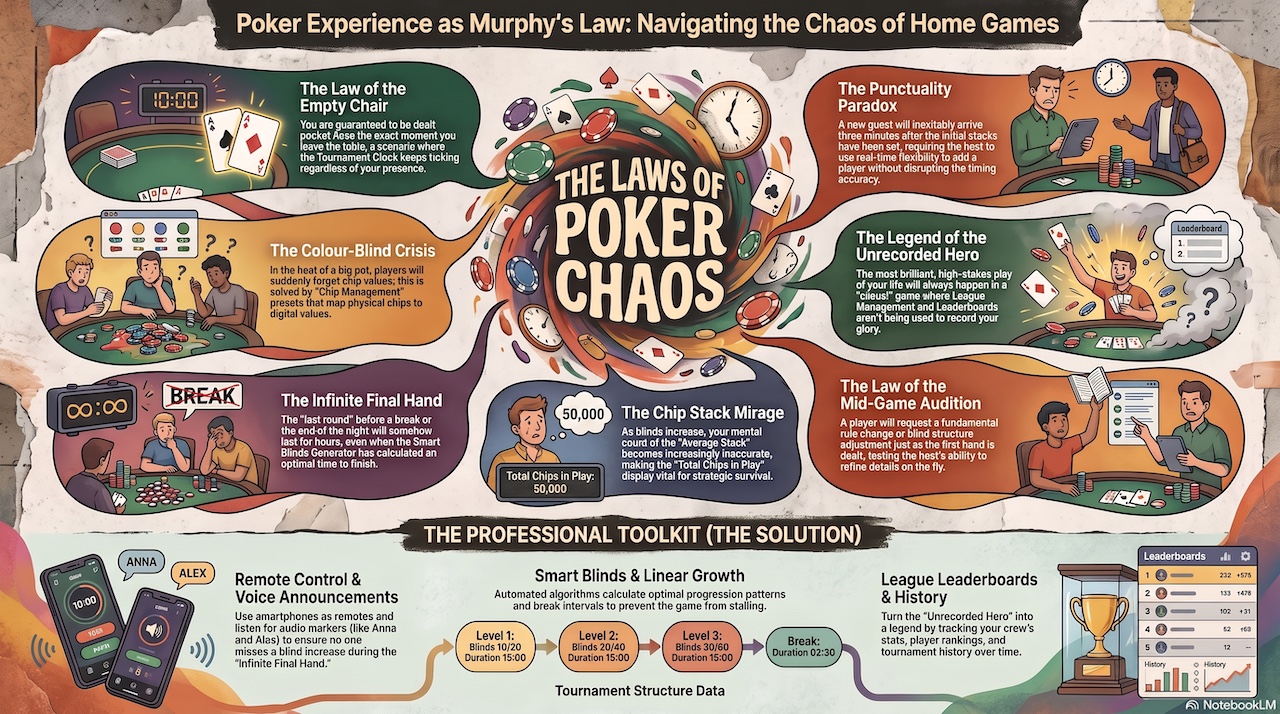
01. The Law of the Empty Chair
The Rule: The quality of the hand you are dealt is inversely proportional to your physical presence at the table. It is a scientific certainty that if you step away for a quick bathroom break or to grab a beverage, you will return just in time to see the dealer mucking a pair of Aces that were meant for your seat. Alternatively, this is the exact moment the blinds will decide to increase, leaving you "blinded out" while you were simply trying to stay hydrated.
02. The Punctuality Paradox
The Rule: The "last-minute" guest will arrive exactly three seconds after the chip stacks have been perfectly counted and distributed. You have spent twenty minutes meticulously calculating the prize pool and stack sizes for exactly six people. The moment the first card hits the felt, a car pulls into the driveway. This player will inevitably be the one who ends up with all the chips by the end of the night, despite missing the first three levels of play.
03. The "Color-Blind" Crisis
The Rule: The largest pot of the night will always occur before everyone has agreed on what the green chip is worth. During a low-stakes moment, everyone is clear on the denominations. However, the second a massive three-way "all-in" occurs, total collective amnesia sets in. One player is convinced the green chips are 25, another swears they are 100, and the host is too busy looking for a missing deck of cards to settle the dispute.
04. The Legend of the Unrecorded Hero
The Rule: Your most brilliant, soul-reading "hero call" will only ever happen in a game where nobody is keeping track of the season standings. If there is a league leaderboard or a trophy involved, you will likely go "out on the bubble" due to a statistical fluke. But in a casual, one-off game where the results are forgotten by morning, you will play like a World Series champion, pulling off bluffs that would make the pros blush.
05. The Law of the Mid-Game Audition
The Rule: The accuracy of any player's "mental count" of the total chips in play is inversely related to how close they are to being eliminated. . Even though a game begins with a clear calculation of the average stack, that number quickly becomes a mythical figure that every player claims to be "just slightly below" as the blinds increase. No matter how carefully the chips were mapped out during the initial setup, a player will inevitably claim they had a high-value chip that has mysteriously vanished just as the stakes transition to the next level.
06. The Law of the Mid-Game Audition
The Rule: The Law of the Mid-Game Audition The urge to add a "last-minute player" or completely overhaul the prize pool payouts will only strike at the precise moment the dealer begins the very first shuffle of the night. Even if you have meticulously planned the tournament structure and calculated the total time to finish, someone will suggest "just one more" refinement to the blind levels or an extra break interval right as the first cards hit the felt . This ensures that any hope of a quick game is replaced by a tactical marathon that pushes the final pot well past everyone’s intended bedtime.
07. The Infinite "Final" Hand
The Rule: The "one last hand" before everyone goes home will inevitably turn into a forty-minute strategic stalemate. When the group decides to play "one last round" at midnight, Murphy's Law dictates that two players will suddenly discover the deepest level of tactical patience ever recorded in human history. What should have been a two-minute shove-fest becomes a grueling battle of wits that ensures no one gets to sleep before 2:00 AM.
Note on Sources
While the themes of these scenarios—blinds, player management, and chip values—are inspired by the technical topics found in the source material, the specific humorous anecdotes and "Murphy's Laws" themselves are creative additions for entertainment purposes and are not explicitly contained within the source documentation.